Amazon A to Z App · People Experience
Self-Service Resignation
Amazon had no self-service way to resign. I led the design of one in the A to Z app, and used it to show people their other options before they left. Then I built the business case that got it funded.
Lead designer
Strategy through ship, working with Legal, HR, Engineering and Product
Tens of thousands
Full-time and contingent employees using the flow worldwide
Retention lift
Tracked through attrition, satisfaction scores and avoided recruiting cost
Situation
Quitting a job is stressful, and at Amazon it was also confusing. There was no single place to submit a resignation, find out what happened next, or see anything that might have fixed the reason you were leaving.
That last gap was expensive. Someone who quits because they want to grow, and never hears about the training or open roles on other teams, has to be replaced. Every one of those exits meant paying for recruiting and onboarding again.
The People Experience Foundation team saw the exit flow as one of the few moments where the company still had a chance to listen. Done well, it could keep some people and give the rest a clean, respectful way out.
"The exit flow is the last moment the organization has to listen. Sometimes it's also the moment it can change someone's mind."
The challenge
I was the lead designer, working with Engineering, Product, Legal, Compliance and People Experience leadership. In practice that meant meeting senior leaders to agree on what we were building, running workshops with stakeholders and employees, and arguing for the employee's point of view in reviews where nobody else was assigned to it.
The flow had to work for two groups: full-time employees and contingent workers, who have different access policies and legal protections. On screen it was a multi-step form with conditional logic. Behind it were four groups who wanted different things:
Employees
Often upset, and needing a flow that didn't read like a legal document
Legal and Compliance
Precise language, documented consent and complete data capture at every step
HR leadership
Retention options shown clearly, without the flow feeling manipulative
Product and Engineering
A system that could roll out globally and grow later
The hardest part was getting the project approved at all. It didn't generate revenue, so I had to show its value in money: what retention and satisfaction were worth in avoided recruiting and attrition cost.
The flow
The flow is six steps in the A to Z app, on mobile and web. Each step collects something, offers something relevant, or confirms intent, and each one gives the employee a way to stop.
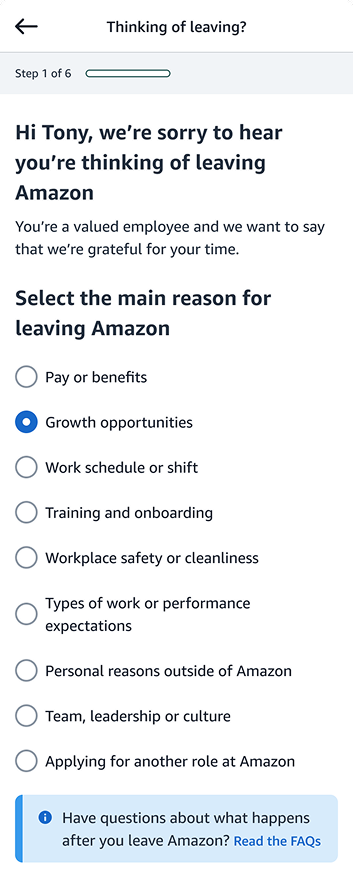
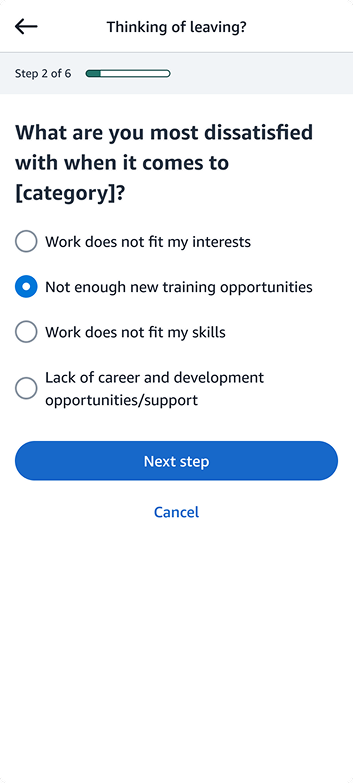
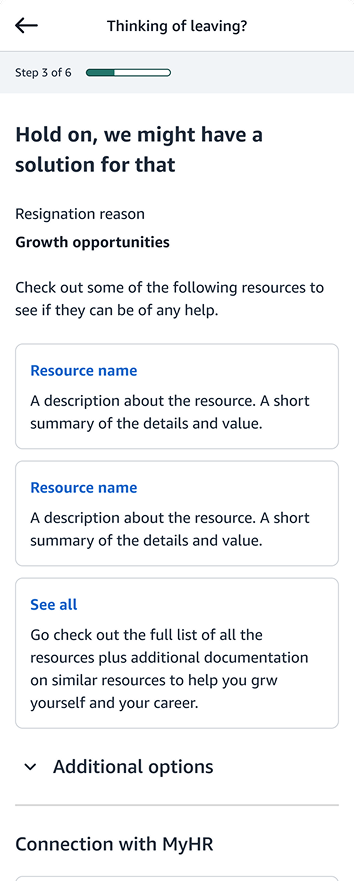
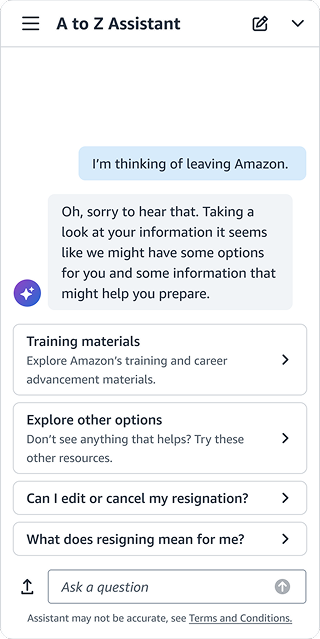
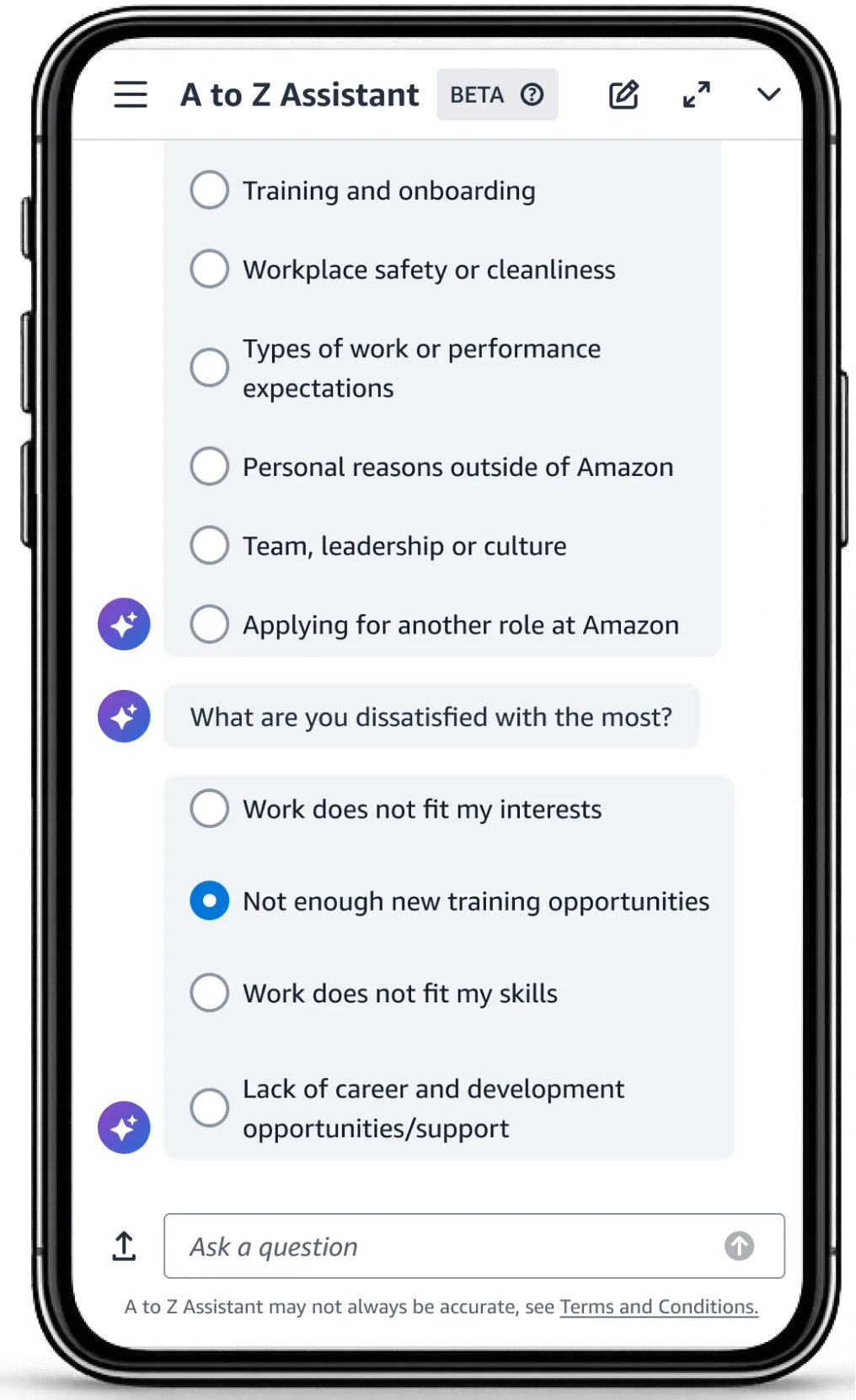
It opens with “Hi Tony, we’re sorry to hear you’re thinking of leaving Amazon” and then asks for the main reason. We spent real time on that sentence: it had to sound like it cared without sounding like a greeting card. The next step asks follow-up questions specific to the reason chosen, and the answers decide what the employee sees after that. Someone leaving over growth sees relevant training courses. Someone leaving over scheduling sees other shift times.
How I led it
Agreeing on the goal before wireframes
Before any design work I met with People Experience leadership to agree on what the flow had to achieve. That included retention numbers, but also how it should feel to the person using it. Then I ran workshops with Legal, Compliance, HR, Product and Engineering.
With that many groups and competing priorities, getting agreement early saved us later. The workshops surfaced assumptions that would otherwise have blown up in design reviews, and gave us a shared framework we went back to every time we had to make a tradeoff.
Discovery: listening to employees who had already left
We interviewed and observed two groups: current employees who had thought about quitting, and former employees who had quit. We needed both. From that research we built service blueprints that tracked full-time and contingent workers side by side, which showed where their needs split and where one design could serve both.
One finding came up again and again. People leaving for “growth opportunities” often didn’t know about internal resources built for exactly that. Nobody had shown them at the right moment.
That finding shaped one of the biggest decisions in the flow. An employee who picks growth as their reason sees training, career development material and a link to the A to Z Assistant right there in the flow. It was part of the design from the first sketch.
The pivot: cross-team training access
Halfway through the project, research and stakeholder conversations turned up something bigger. Employees didn’t only want more training. They wanted training from other teams. They weren’t trying to get better at their current job; they were looking for a future somewhere else inside Amazon.
That changed what we were building. The resignation form became a place to offer people a reason to stay.
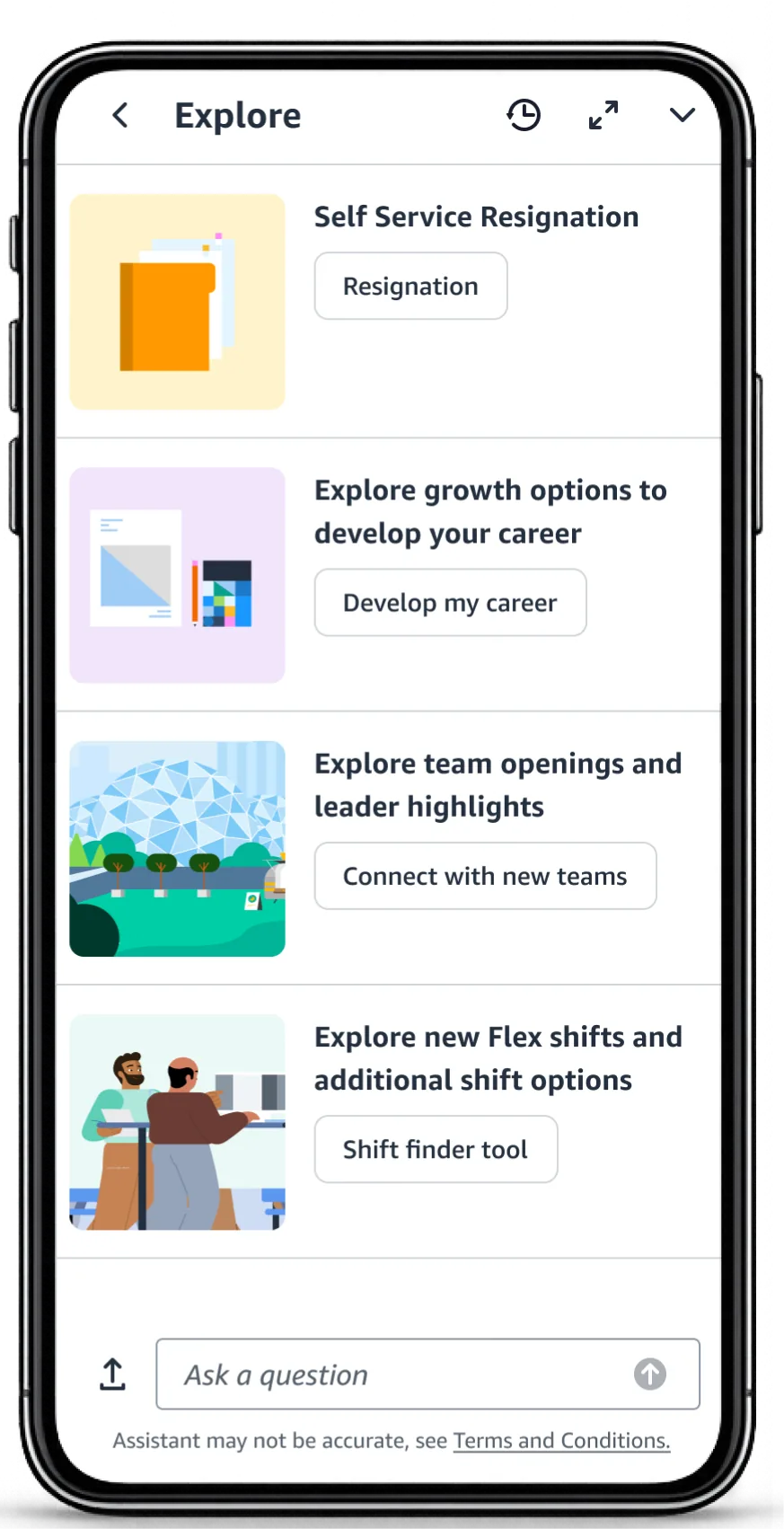
The Explore hub came out of that. Whatever the reason for leaving, it shows four options side by side: career growth resources, team openings and leader profiles, flex shifts, and self-service resignation.
Designing the A to Z Assistant integration
We also connected the flow to the A to Z Assistant, the AI support tool built into the app. The Assistant had to recognize when someone typed that they wanted to quit, reply with something useful and kind, and walk them through a structured set of choices without sounding like a bot.
That meant working closely with Engineering on the language model and with Legal on the exact wording of consent and confirmation. Most of it happened through fast prototypes and stakeholder critiques, with each round of feedback built into the next prototype before a wider review.
Confirmation, compliance, and the right to change your mind
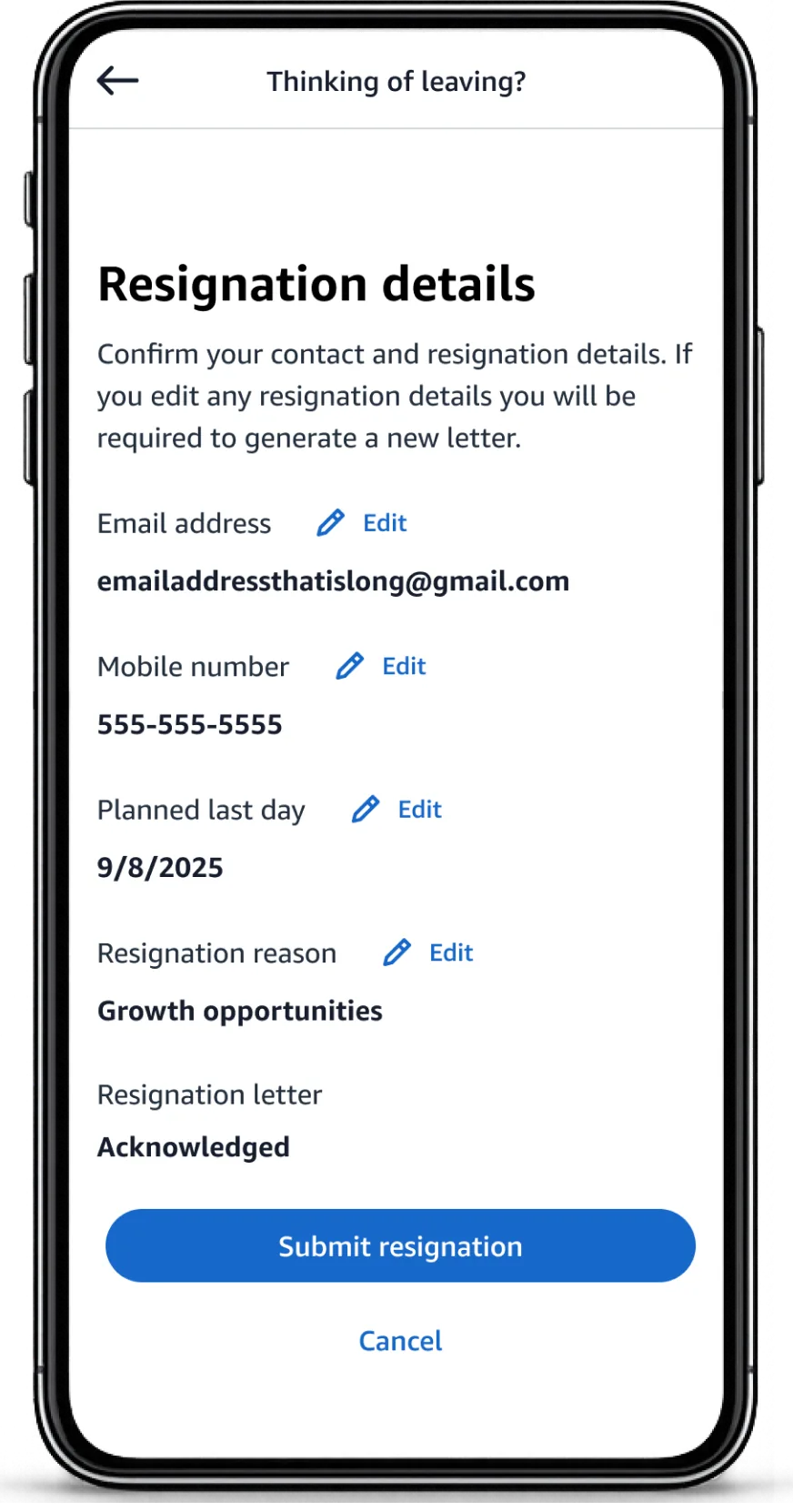
Legal and Compliance shaped the last steps most. The final screen summarizes everything, with an edit link on each field, so people can check it before they submit. It also tells them plainly that they can change their mind up to 24 hours before their last day.
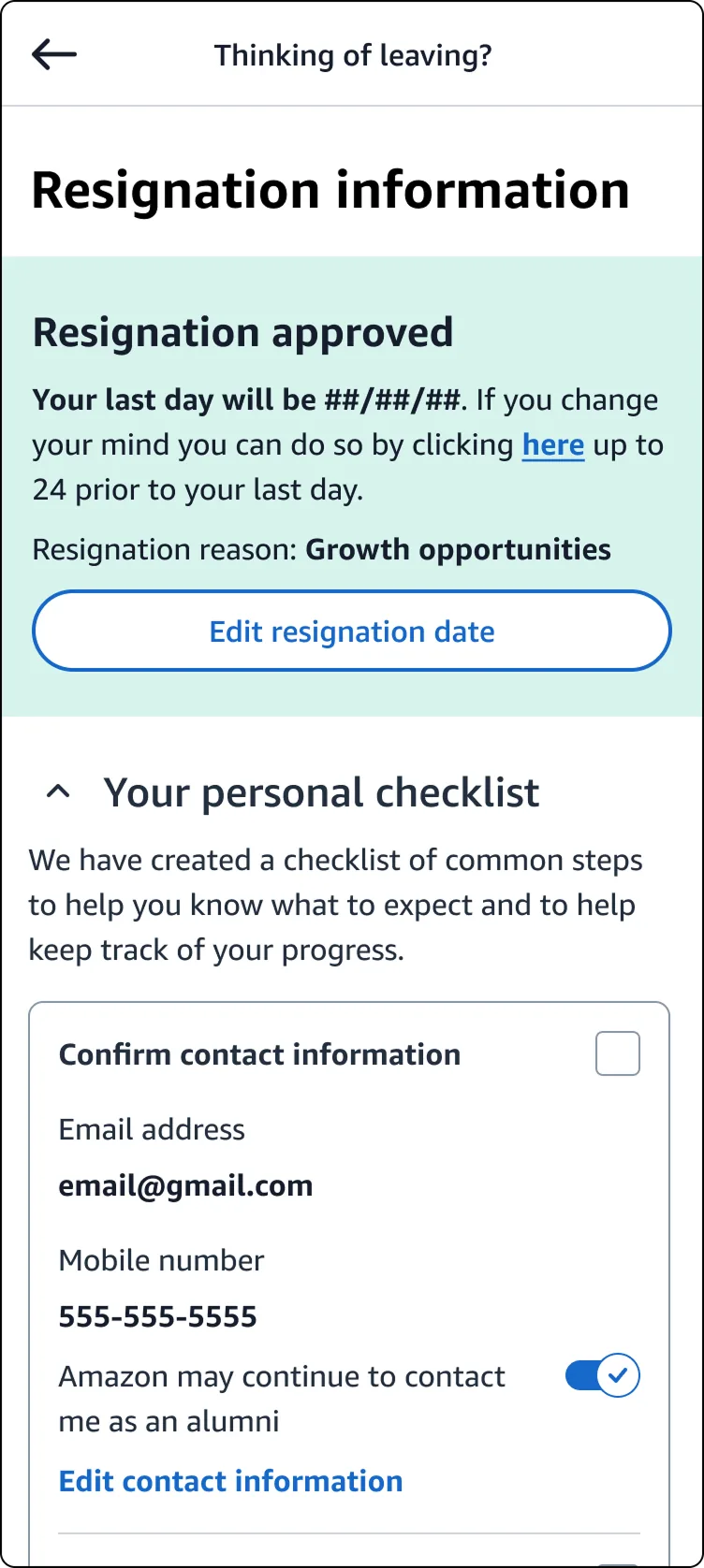
After submitting, employees see a Resignation Information page with their last day, a personal checklist of next steps, and a link to the alumni experience in A to Z. Canceling takes one deliberate confirmation, enough to prevent accidents but not enough to trap anyone. The same rule held across the whole flow: the decision belongs to the employee, and the company gets one honest chance to offer an alternative.
Outcomes
The flow shipped within the planned 3–6 months. It’s live in the A to Z app for tens of thousands of full-time and contingent employees worldwide.
Retention lift
Lower attrition among the employees the flow reached
NPS improvement
Higher employee satisfaction scores after launch
Cost savings modeled
Avoided recruiting spend, the number that kept leadership funding the work
The exact figures are confidential. I’m happy to walk through how we measured each one in conversation.
The business case
The piece of this project I’d point to first is a spreadsheet. I modeled what it costs to replace someone who quits (recruiting, onboarding and lost productivity) and set that against the retention we measured. That gave People Experience leadership a way to judge employee-facing projects in dollars, and it changed how they prioritized that work afterwards.
Org-level impact
The side-by-side blueprints for full-time and contingent workers are now a reference for other PX Foundation projects. The pattern for connecting a structured form to the A to Z Assistant is being reused in other self-service HR features. And the idea of treating an exit flow as a chance to retain people has spread across the People Experience organization.
Reflection
Most of my time on this project went into getting Legal, Compliance, HR, Product and Engineering to agree, when each had good reasons to want something different.
I spent a lot of time translating. Lawyers needed to hear about risk, engineers about scope, business leaders about cost, and all of them needed to hear what it was like to be the person quitting. Designing for two populations with different legal rights meant thinking about the whole system, not one flow. And getting a people project funded in a company that runs on measurable output meant doing the financial model properly enough that nobody could wave it away.
I still think about the cross-team training finding. Nobody asked us to look for it. It came out of spending enough time with employees to hear what they were hinting at: more than any particular course, they wanted proof the company thought they could grow.